
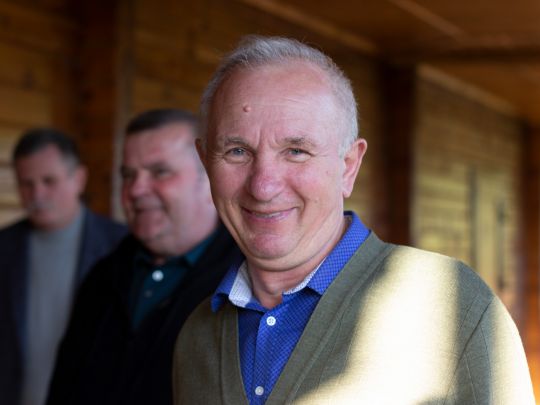
Every day, a pastor from the village of Rokytne in the Rivne region, Vladimir Brichka, father of 12 children and grandfather of 43 grandchildren, travels to hot spots. Brings aid to military personnel and evacuates civilians. Vladimir himself can no longer calculate how many people he was able to take to safe places during the 15 months of a full-scale invasion. It’s not even hundreds, but thousands. When, on February 24, Russian troops began to bomb the whole country and occupied part of the Kiev region, a few days later Volodymyr Brichka organized a headquarters for helping the Armed Forces of Ukraine in his native village, and he, together with the same volunteers, went to Vorsel in the Kiev region, where he saved 53 children from an orphanage in the occupation .
“The children survived only thanks to the nannies, who walked 4 kilometers daily to get water for them”
“At first we didn’t know about these children, - tells 68-year-old Vladimir Brichka. - The fact that there is an orphanage in Vorzel, where children sit in the basement without electricity, gas and heat, we were told by residents of Belogorodka, which we managed to break into in early March. I love children very much, and this news just broke my heart. That’s why we went there right away. Many children there were with severe chronic diseases, cerebral palsy. They needed special care and survived only thanks to the nannies, who walked 4 kilometers daily to get water for them. On the street, nannies boiled porridge and heated water, which they poured into bottles, and surrounded the children with these bottles to warm them in a cold room. Many children could not sit up on their own, so in addition to them, we took young people into our minibus who could hold them in our arms. With God’s help, we escaped from Vorzel. They brought all the children alive, warmed them up … We took the children to Kyiv, and from there they were evacuated to Chernivtsi. Later, when information about this story appeared on social networks, people from different parts of the country began to write to me: “How can you adopt these children? Where to go? It moved me to tears.
For Volodymyr Brichka and his fellow villagers, who joined him at their own peril and risk, this was only the beginning. After making sure that the children were safe, the pastor and volunteers again went to Vorzel, this time to evacuate pensioners from the nursing home.
- When we arrived, many of them were found, unfortunately, already dead, – says Vladimir Brichka. - We took away everyone who was alive… Then they took all the local residents who only fit into our buses. We returned there many times and took out 300 people a day. They brought people to safe places, placed them in churches, schools and kindergartens. Some I took home with me. For example, a grandfather from Ivankov, Kyiv region, whom I met by chance at a Ukrainian checkpoint. He himself, at the age of 85, escaped from the occupation and was able to ride a bicycle to Malin, Zhytomyr region. There he asked our military to warm up at their checkpoint. I asked where to take him. “Somewhere,” Grandpa replied. He was ready to ride his bike all the way to the border. I brought him home. My wife and I warmed him up and fed him. They said that now they can live with us. But when he charged and was able to turn on the phone, he got a call from his daughter from Germany, who had not heard anything from him for more than a month. How they cried … She took her father to her, and now grandfather has an exercise bike instead of his old bicycle …
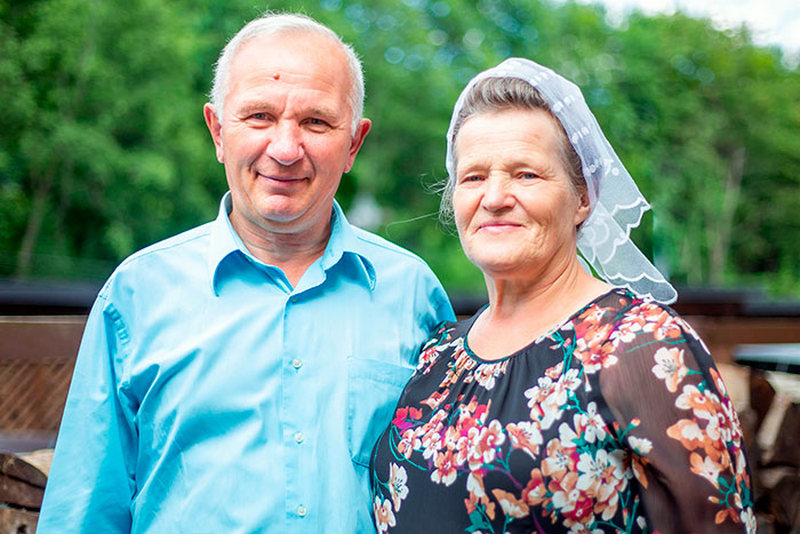
We also had a great family from Kyiv - mother, son and grandmother, who then left for Norway. And now the grandmother lives, whom I recently took away from Bakhmut. She is 83. Her son died, and there is no one else from her family. Thinking that no one needed and she had nowhere to go, she remained in Bakhmut, where there was already a real hell. I took her from the ruins, brought her home. “Our parents are already dead,” he told her. “You will be for your mother.” How happy she was. After a year, life under constant shelling suddenly found itself in a calm, quiet place in the family. Young people from our church often come to it, communicate with it, bring food. I look at her and see how the person has changed, he is happy. And I rejoice with her.
In the village of the Rivne region, where Vladimir Brichka lives, there is a whole headquarters with a field kitchen, places for refugees and cars, which arose in the village literally in the first days of a full-scale war.
- You may not believe it, but in all this time I have never had to ask anyone for a penny. People organized themselves and did everything in their power. says Vladimir Brichko. - Everyone who had minibuses immediately said that they were going to Kyiv with me. At first, we distributed food there in the subway and bomb shelters. And there they heard that people had gathered in the occupied Belogorodka trying to evacuate. They said that they were even promised a green corridor, but there was no one to take them out. And we have seven guys in minibuses. I asked them if they were ready to leave. They replied: “If you are leaving, we are with you.” And we left.
“When you come to a city or village after the de-occupation, you see terrible things there. The remains of the people who were shot were burned alive.”
At the very entrance to Belogorodka, the volunteers came under the first massive shelling. Then there were interrogations and searches at the checkpoints of the occupiers:
- When we nevertheless managed to break through in Belogorodka, we saw a lot of people there. With animals, bags… They were all standing along the road, hoping to catch a car and leave… I wanted to help everyone, and in the following weeks we did just that. We got into different situations, our cars repeatedly needed repairs after shelling. Every time we go on such a trip, we understand that anything can happen.
In the first weeks of the war, two of our volunteers were killed in the Borodyansk region. The guys were delivering bread to people and came under fire from the invaders. One of them received severe wounds - in the stomach and chest - and died a few days later in the hospital. And the second one disappeared. We hoped that he might have been taken prisoner, but he is alive. And after the de-occupation of the Kiev region, it turned out that he died. It turned out that the Russians, having shot him, also threw a pomegranate into the car with grenade products. I found this car… I packed the remains of our burnt volunteer into a bag, brought them home to bury…
When you come to a city or village after the de-occupation, you see terrible things there. The remains of the people who were shot were burned alive… I will never forget what we saw in the Kiev region. And in Izyum and Kupyansk, where food was taken away the next day after the de-occupation. Corpses were everywhere - on the roads, on the sidewalks, in forest plantations … We constantly travel to the de-occupied regions. We help rebuild destroyed homes. Residents of the houses that we have begun to restore often cannot believe that we are doing all this for free. I remember how we arrived in Chernihiv region together with the builders, with the chairman of our UTC. They brought windows and building materials to repair roofs for people. And people began to refuse: “No, no, we have nothing to pay you with.” We explained that nothing is needed. We just want to help.

The purchase of building materials and all these trips of ours are possible only thanks to good people. For a year and three months of a full-scale war, those wishing to join us have not become less, but only more. As in the first month of the war, fellow countrymen constantly come to me asking how to help. Both pensioners and entrepreneurs and officials from the district administration come. Many help from abroad. Most of my children live in the US and regularly send substantial aid from there. Knowing that we are planning another trip, Orthodox priests also come to help. Pastors who have long emigrated abroad also help. And even women travel with us to hot spots. Many in order to see there a husband, son, brother, who are at the front. And these women help in the field kitchen, supply the soldiers with hot meals.
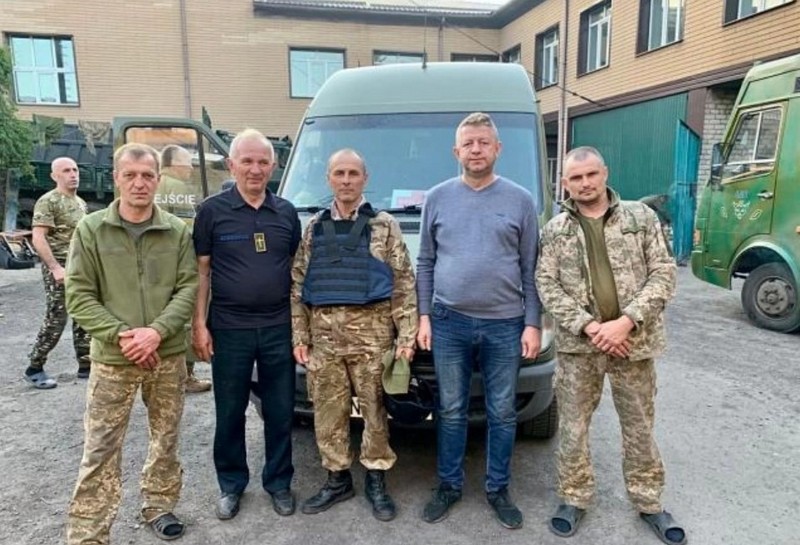
As for Vladimir Brichka himself, his trips to hot spots began long before the full-scale invasion. Back in 2014, the pastor learned from one of the parishioners about women with children in Svyatogorsk, Donetsk region, who had to hide in the forest due to hostilities. Having collected three tons (!) of products, Vladimir left to help. He says what he saw shocked him to the core. The pastor began to evacuate people to safe places.
- That’s how it all started. Vladimir recalls. - I always say that volunteering is contagious and very addictive. Once you start, you can’t stop, because you understand that help is needed both there and there … Each of our trips, each evacuation is someone’s life that we have a chance to save. In winter, we carried firewood and potbelly stoves to the front-line zones. I had to carry up to 6-7 trucks with firewood at a time. But it helped people in the same Kherson region to survive the winter. Not everyone can go anywhere. Someone cannot leave their relatives, someone has neither the strength nor the means to start life from scratch in a new place. There are a lot of elderly people in frontline towns and villages. And often it depends on our help whether they survive or not.
There is a lot of work at the pastor and in the rear - the church actively helps widows and families divorced by the war.
- The psychological state of people is no less important than the physical, - says Vladimir Brichka. - Therefore, we conduct consultations for military personnel and their families, wives and children of the dead. Many people will need post-war rehabilitation. She is needed now. This is another important area that we are engaged in and plan to do even more.
“God grant that there is enough strength for everything …
“The results of our work give me strength. When I see the joy of the military, whom we fed with hot meals. Or the eyes of our grandmother from Bakhmut, who until recently thought that life had ended, but it turns out that it continues. When I communicate via video link with my grandfather from Ivankov, who after a short time became like a family to me. When you realize that someone managed to help, this is real happiness.
Earlier talked about the founder of the Halabuda hub, who disappeared in Mariupol a year ago, Dmitry Chicher. Dmitry’s wife said that until the last moment he was looking for an opportunity to evacuate people.
Source: Fakty

I am Joseph Zeman, a journalist who mostly covers world news for the Daily News Hack. I pride myself on being able to find and report stories that others might miss. I have a knack for being able to see both sides of every issue and this allows me to provide readers with well-rounded stories. In addition to my work as a journalist, I am also an author and have written several books on current affairs.

