
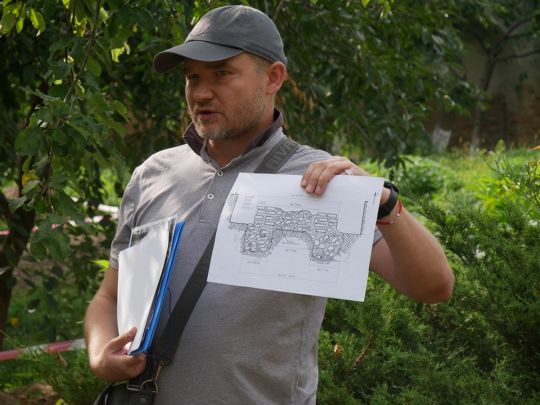

- In the updated museum exposition of the ancient Kyiv Church of the Savior on Berestov, we presented the history of archaeological research in this temple, starting from 1914 - told Head of the Sector of Archeology of the National Reserve “Kyiv-Pechersk Lavra” Sergey Taranenko. - Oneone of the most intriguing in this story is the search for the tomb of the founder of Moscow, Prince Yuri Dolgoruky (by the way, during his lifetime, the people of Kiev were hostile to him, according to one of the probable versions, he did not die a natural death - the prince was poisoned). For a long time it was not possible to find at least something similar to the grave of Dolgoruky. And when they nevertheless found two princely sarcophagi at once, it remained unclear who owned the skeletons lying in them. Their research dragged on for many years. And just recently, Russian professor Doctor of Medical Sciences Viktor Zvyagin published the results of analyzes of bones from one of these sarcophagi. Laboratory studies seem to give grounds to assert that these are the remains of Prince Yuri Dolgoruky. However, we have justified doubts not only that these are the bones of the prince, but in general that they belonged to her husband.
“The search for the tomb of Yuri Dolgoruky was carried out not only for conscience, but also for fear”
- How is it generally known that the founder of Moscow is buried in Kyiv in the Church of the Savior on Berestov?
.jpg "Нині церква Спаса на Берестові складається з декількох частин, споруджених в різні часи. Одна — княжої доби ХІ-ХІІ століть. Друга — прибудована з ініціативи митрополита Петра Могили. А третя (дзвіниця) з’явилась тільки в ХІХ сторіччі. Зараз всі три частини становлять єдине ціле. Фото з https://upload.wikimedia.org")
- We know this from the chronicle: it says that Dolgoruky died in 1157 and was buried in this temple. It should be said that the Grand Dukes of Kyiv (one of them was Yuri Dolgoruky) and their closest relatives were buried after death, as a rule, in sarcophagi from pyrophyllite slate, which is mined in the Zhytomyr region. On the eve of the 800th anniversary of Moscow, which was celebrated in the USSR in September 1947, the authorities sent an expedition to the ancient Church of the Savior on Berestovo in Kyiv with the task of finding the tomb of Yuri Dolgoruky. The search was carried out very carefully - not only for conscience, but also for fear (there is no doubt that scientists were afraid of failing the state task, because the punishment for this in Stalin’s time could be extremely severe). But they never found the sarcophagus.
Read also: “Near the walls of St. Sophia of Kyiv, we found a fragment of an ancient golden icon, probably Byzantine”: archaeologist spoke about a unique find
But after 35 years, luck unexpectedly smiled at two Kyiv archaeologists Vladimir Gonchar and Viktor Kharlamov. They did not even carry out excavations in the Church of the Savior on Berestovo - they simply carried out archaeological supervision of putting the territory near this ancient temple in order. It so happened that the bulldozer bucket accidentally stumbled upon the sarcophagus! Lucky to find another one. So the achievement of successful archaeologists was immediately 2 princely sarcophagi! But the real excitement around these finds arose about 15 years later, when Gonchar published the abstract of an article in which he stated that in one of the sarcophagi were the remains of Yuri Dolgoruky.
.jpg "Один із пам'ятників Юрію Долгорукому. Фото з сайту https://www.eg.ru")
Did the archaeologist have proof of this?
“There was no conclusive evidence. To figure out whose bones lay in this sarcophagus, they had to be carefully examined. After Gonchar’s loud statement, the theme of the remains of the skeleton of the founder of Moscow was immediately picked up in Russia. Then (2006, 2007), relations with the Russian Federation were more or less acceptable, so bone samples were handed over to its scientists for examination. This made sense, because the Russians have the remnants of princes from the Rurik family (for example, the son of Yuri Dolgoruky Andrei Bogolyubsky). Therefore, they can compare their DNA with the DNA of human bones found in a sarcophagus near the Church of the Savior on Berestovo.
Read also: Asphalt failed again in the center of Kyiv: a basement of a manor from the beginning of the 19th century was found under it
But year after year passed, and Russian scientists did not publish the results of these studies. In general, it was not known whether they carried them through. Suddenly, recently the Russian professor Viktor Zvyagin (he, by the way, raised more noise around the finds of Gonchar and Kharlamov) said that it was impossible to make a DNA examination due to the fact that the remains were poorly preserved. According to him, other analyzes were carried out, which give reason to say that the bones of Yuri Dolgoruky were in the sarcophagus.
“Princely sarcophagi, like the Egyptian pyramids, were robbed in antiquity”
- The remains of a person lying in this sarcophagus were studied by unbiased scientists?
- Yes. The Institute of Archeology of the National Academy of Sciences of Ukraine handed over bone samples to Swedish specialists for DNA testing. Experts from the laboratory of genetics at Stockholm University have identified suitable DNA for examination. It turned out that it does not have a Y chromosome. This circumstance made it doubtful that the remains of a man lay in the sarcophagus - it is quite possible that they belonged to a woman. But this is not the only fact that makes one skeptical about the version that this is the skeleton of Prince Dolgoruky.
.jpg "Після проведення аналізів російський професор заявив, що цей кістяк належав князю Юрію Долгорукому. А шведські вчені, виконавши ДНК-експертизу, заявили, що це, ймовірно, останки жінки.")
What other facts testify against this version?
- In ancient times, Kyiv was many times subjected to ruthless robbery by various conquerors, in particular princes (in this regard, we can again mention the Vladimir-Suzdal prince Andrey Bogolyubsky). And what a catastrophe Kyiv experienced in 1240, when it was captured by the hordes of Batu! The tombs of the princes were tasty prey for voracious aggressors, because there, I think, there was something to take. Princely sarcophagi, like the Egyptian pyramids, were robbed in antiquity.
.jpg "Саркофаги знайшли ще у 1989-1990 роках, а результати дослідження, знайденого в одному з них кістяка, розтягнулися на три десятки років. І крапка у цій історії ще не поставлена")
Read also: A long-awaited victory: the court in Amsterdam decided to transfer the “Scythian gold” to Ukraine
By the way, once in Kiev Podil during archaeological excavations, we found in one of the ancient graves the remains of clothes with gold embroidery, which were on the deceased. Ordinary fabric has long decayed, but the gold embroidery has been preserved. Why am I saying this? Can you imagine what kind of clothes they put on the deceased Kyiv prince before putting him in a sarcophagus? I am convinced that it was a very rich garment, probably with gold embroidery. Also, expensive things, weapons were probably put in the sarcophagus.
Let’s go to the stand, which demonstrates what we found in one of the graves near the Church of the Savior on Berestov. This is the burial of some officer of the XVIII century. You see, the metal buttons on the uniform, boots (they managed to be restored), a glass of vodka survived. By the way, an anthropological examination showed that this officer suffered from syphilis during his lifetime. But that’s not the point. It is important that in the surviving, not robbed burial of a military man, his things lay: clothes, shoes, and even a pile at the right shoulder.
- Do you want to say that if the old prince’s sarcophagus had not been robbed, the things of the prince would have been there?
- Exactly. But there was nothing but bones. Another important circumstance: in the 16th-17th centuries, there was a practice of reusing sarcophagi: the skeletons located there also removed the hoards of the bodies of people who had recently died. They didn’t see anything immoral in those days.
By the way, the famous Metropolitan of Kyiv Peter Mohyla, on whose initiative the Church of the Savior on Berestov and other ancient churches of Kyiv (for example, St. Sophia Cathedral) was restored, was buried in a sarcophagus of princely times. If it was not empty, then the remains of some person were removed from there and the Metropolitan was laid down. I would like to note that in the Church of the Savior on Berestovo we have not only opened a new museum exposition, but also a tablet exhibition dedicated to Peter Mogila (curated by Konstantin Krainy, Deputy General Director of our reserve).
- Do the sarcophagi found near this temple have inscriptions that can be used to determine which of the princes was buried there?
- Unfortunately, there are no inscriptions on them.
“From the very beginning of the 21st century, the church was closed for restoration for almost 20 years”
- You said that archaeologists Gonchar and Kharlamov found 2 ancient sarcophagi here. What was in the second?
- Skeletons of an elderly man and a young woman. There is an assumption that these are the remains of the son of Yuri Dolgoruky Gleb and his wife. But this version should be carefully checked. By the way, there is a legend that Prince Gleb, like his father, was poisoned by the people of Kiev.
.jpg "Сергій Тараненко показує, де приблизно було знайдено один з княжих саркофагів. Вчений розповів, що в XVI–XVII століттях існувала практика повторного використання саркофагів: скелети, які там знаходилися, прибирали і клали тіла людей, які нещодавно померли. Нічого аморального в цьому не вбачали. Фото автора")
I note that back in 1914, architect Pyotr Pokryshkin found, again, not inside the Church of the Savior on Berestov, but near its walls an ancient sarcophagus dug into the ground. According to the most probable version, Yuri Dolgoruky’s sister Euphemia was buried there. But its remnant has not been preserved. It is important that in the course of these studies, Pokryshkin was able for the first time to determine the age of the Church of the Savior on Berestovo - it was built at the end of the 11th - beginning of the 12th centuries.
.jpg "В інтер’єрах храму зберіглася фреска княжої доби «Чудесний лов риби» («Явлення Христа учням на Тиверіадському озері». Фото з https://upload.wikimedia.org")
It turned out that in the annals there is information about 3 princely tombs in the Church of the Savior on Berestovo: Yuri Dolgoruky, his son Gleb and Euphemia. And just 3 sarcophagi were found. But that doesn’t mean there’s no chance of finding more. After all, other princes of the Monomakhovichi branch could be buried in this temple, but no record of this could be made in the annals.
- I wonder why all 3 ancient sarcophagi found were not inside the church, but outside its walls?
- On the princely day, the tradition of burying respected persons was both inside and outside the temple.
As for the Church of the Savior on Berestovo, it should be said that it has not been completely preserved - part of this ancient temple has been destroyed. Currently, it consists of several parts built at different times. One - princely times of the XI-XII centuries. The second one was built on the initiative of Metropolitan Peter Mohyla. And the third (bell tower) appeared only in the 19th century. Now all three parts form a single whole. I will also note that the fresco of the princely era “The Miraculous Fishing” (“The Appearance of Christ to the Disciples on Lake Tiberias”) has been preserved in the interiors of the temple.
.jpg "Фрагмент російського снаряда, що потрапив у купол церкви Спаса на Берестові 1918 року. Фото Сергія ТУШИНСЬКОГО, «ФАКТИ»")
Despite the fact that the Church of the Savior on Berestov is located in the very center of the city, on Pechersk, not all Kievans are familiar with this unique ancient landmark. A possible reason for this is that from the very beginning of the 21st century, the church was closed for restoration for almost 20 years. Even after the completion of works in September 2019, it was opened for visitors only for a short time. Finally, the National Reserve “Kyiv-Pechersk Lavra” opened it to the public. The renovated exposition of the church presents very interesting finds. In particular, a fragment of a shrapnel shell that hit the dome of this temple in the winter of 1918 during the shelling of Kyiv by Russian Bolsheviks led by the infamous leader Mikhail Muravyov. He placed cannons on the left bank of the Dnieper near Darnitsa and ordered to shoot at the city, using the domes of churches as landmarks. This fragment was found during restoration work - it was stuck in a wooden beam near the dome of the Church of the Savior on Berestovo. A little more than 100 years have passed, and Russian monsters are again being driven around Kyiv. This time with missiles.
Earlier wrote about another discovery of archaeologists - a super find in the Kiev-Pechersk Lavra.
On the photo in the header Sergey Taranenko
Source: Fakty

