
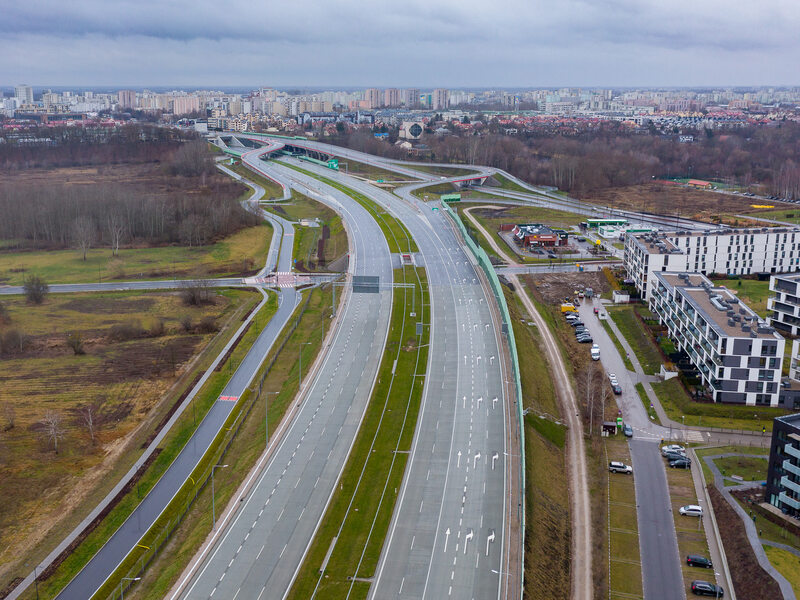

The General Directorate of National Roads and Highways has finally lifted the hourly restrictions for vehicles over 16 tonnes on the S2 between the Opacs and Lubelska junctions. The introduced permanent traffic organization allows trucks to pass the entire S2 through Warsaw at any time.
For four months, the GDDKiA monitors the movement of vehicles and the behavior of drivers, especially during peak hours. Here are the results:
-
less traffic and improved security on DK50 and S8 Janki - Opacz;
-
traffic flow improvement at critical points on DK50: roundabouts, intersections and traffic lights;
-
lack of difficulties for trucks over 16 tons when moving from west to east of Mazovia;
-
there are fewer vertical characters on S2, which gives better readability of the marking;
-
less occupancy of the CC on A2.
The main conclusion is an increase in the intensity of truck traffic on the southern bypass of Warsaw S2. In the first measurement period, August-September 2022, it increased by about 10-12 percent. Preliminary results of the analysis showed that the changes made did not have a negative impact on the behavior of drivers, and the observed increase in traffic volume is acceptable for the operation of S2 and the tunnel. Despite the increase in intensity, there were no serious traffic accidents.
DK50 will be better
In addition, a very positive development was observed on the DK50, where heavy vehicle traffic decreased by about 25%. On this road, which is mainly a single carriageway with two lanes, the change should lead to a significant improvement in road safety. Improvements in traffic flow are already being seen at critical DK50 points such as roundabouts, traffic lights and intersections.
In addition, a 14% decrease in truck traffic was recorded on the S8 highway between the Konotop and Marki junctions.
A smaller number of trucks were seen at the MOP on the A2 near Warsaw. Also, there are no more situations in which, due to lack of space for a mop, they parked on the inclusion or exclusion lanes.
First Anniversary of the Tunnel in S2 POW
During the year, about 23 million cars passed near Ursynow. This shows how necessary this route is, which also serves as a link between the districts of Warsaw. During this time there were no breakdowns or serious traffic accidents.
User safety is monitored 24 hours a day, 7 days a week by Tunnel Control Center dispatchers. It is they who control the situation in the tunnel. They cooperate with the State Fire Service and the police in the field of combating threats.
Safety in the tunnel is also affected by the operation of the sectional speed measurement. According to the General Inspectorate of Road Transport, which is responsible for the operation of the IPF, more than 46,000 vehicles have been registered. cases of exceeding the speed limit by the driver.
More than 99 percent of drivers comply with the limit, and if they exceed the speed limit, then at the lowest threshold, i.e. between 11 and 20 km/h, more than allowed by the regulations. This is 67 percent. all reported violations.
No to vehicles carrying hazardous materials through the tunnel
GDDKiA also reminds that vehicles carrying dangerous goods cannot pass through the tunnel. The decision was made by management based on specialized analyzes carried out, as well as the conditions of the tunnel location. The existing infrastructure and activities related to the elimination and prevention of accidents involving hazardous vehicles also had an effect. This decision is also consistent with the recommendation of the head of the tunnel security service and the opinion of the head of the State Fire Service of the Mazowieckie Voivodeship - independent units for the transport of hazardous materials.
GDDKiA also took into account the passage of the route through one of the most densely populated areas of Warsaw, as well as the lack of infrastructure necessary for operational activities, such as parking for vehicles transporting hazardous materials. In addition, there are no main roads marked in Mazovia for vehicles transporting hazardous materials.
All of the above circumstances prompted the GDDKiA to decide to impose a ban on the passage of vehicles carrying hazardous materials through the tunnel at this stage, i.e. assign the category E to the object.
Source: Wprost

