
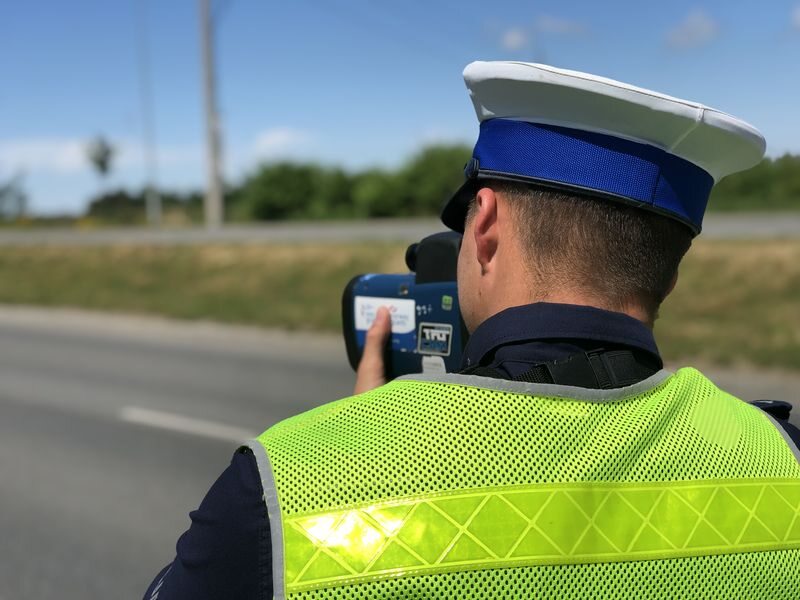
Ombudsman Marcin Węczek proposed to the Ministry of the Interior and Administration to change the rules for the tariff of fines to take into account the “error” of measuring instruments. The Ministry rejected this proposal, which means that we will still receive a fine for exceeding the speed limit even 1 km / h faster than allowed.
Let’s remember. The introduced fine for exceeding the speed limit on the road from 1 to 10 km/h caused objections from the Commissioner for Human Rights. According to some drivers, it is unreasonable to punish for exceeding the speed limit even by 1 km/h. They claim that the measurement error of both gauges and indicators in cars is 3 km/h. Therefore, it must be assumed that the measurement is burdened with a certain error, which will lead to sanctions for such an offense.
“Taking into account the margin of measurement error for laser devices should mean recognizing that exceeding the speed limit in the range of 4 to 10 km/h should be punished rationally,” Ombudsman Marcin Wionczek wrote to Minister of the Interior and Administration Mariusz Kaminski.
In this context, the Ombudsman pointed to the example of France, where speeding tickets are imposed using the value shown by the measuring device, decreasing it in favor of the driver by the amount of the permissible measurement error.
What are the drivers complaining about?
The Ombudsman accepts applications in connection with the application of the Decree of the Ministry of Internal Affairs and the Administration of September 15, 2022, issued on the basis of an amendment to the Law on Road Traffic of December 2, 2021, on the registration of drivers who violate traffic rules. regulations. It includes eg. in table E10, the tariff that forms the basis of the fine for speeding “up to 10 km / h” - that is, in fact, from 1 to 10 km / h.
The applicants argue that punishing drivers for exceeding the speed limit by even 1 km/h is unreasonable and irrational. They indicate that the measurement error of both speed gauges used by the police and other services (including speed cameras) and speed indicators in cars is 3 km/h. In special situations, the error can reach 10 km / h.
The problem is related to the unnoticed problem of measurement error, the so-called “error margin” or “technical margin”. In such situations, the accused can only refuse to accept the mandate. Only in court can he try to prove the measurement error by collecting evidence.
The conclusions of citizens that each device for measuring speed is burdened with a certain lack of measurement accuracy are confirmed by the opinions of manufacturers, as well as regulatory documents.
How could the rules be changed?
Accounting for the measurement error of laser devices should mean that the table should reasonably authorize exceeding the speed limit in the range of 4 to 10 km/h.
The law, which usually justifies the imposition of sanctions for violation of traffic rules, should also contain guarantees for the resolution of doubts in favor of the accused already at the time the potential offense is discovered by the authorities.
The mandate can be waived. However, the punishment imposed by the court can be much more severe than a fine. And the economy of the judiciary is negatively affected by the initiation of time-consuming and costly litigation, in which the question of the measurement error of the instrument showing the speed limit of 1.2 or 3 km/h must be resolved with the help of an expert. opinions.
french pattern
A decision based on the legal resolution of the existence of a measurement error would not be sensational. The imposition of fines for offenses consisting in exceeding the speed limit by the speed indicated by the measuring device, with its decrease in favor of the driver by the value of the measurement error, is accepted, for example, in France.
The fundamental difference between the French and Polish rules is that the establishment of a measurement error by a normative act, which takes place in both countries, does not affect the legal status of the driver in Poland and does not directly translate into the release of the accused from liability or mitigation of punishment.
According to the Commissioner for Citizens’ Rights, the expected solution, which will clearly have a positive impact on the rights and freedoms of citizens, would be to assume that the measurement indicated by the device is subject to a certain error, which in turn would lead to the imposition of sanctions based on “accepted measures”. The “measurement taken” will be the result of the measurement indicated by the device, minus the maximum measurement error limit.
This mechanism will also contribute to facilitating ships in cases where the speed measurement is challenged by these minimum values.
The Ombudsman submitted to the Minister the initiation of legislative work aimed at adopting a resolution authorizing the inclusion of a measurement error in “borderline” situations in favor of the accused and changing the volume of the new tariff included in Table E10 (from exceeding the speed limit to 10 km/h).
ministry says no
And the resort? The Ombudsman replied, and the text with the answer was signed by Maciej Vasik, Secretary of State at the Ministry of Internal Affairs and Administration. “I can assure you that the Ministry of the Interior and Administration sees no urgent need to initiate changes to the extent requested by the Commissioner.”
Minister Vasik justified that control devices are checked, and roadside checks “refer to the activities carried out during the procedure of legal metrological control of devices, including initial and re-verification”.
Thus, they do not cover activities carried out by police officers in traffic control.
Finally, Minister Wasik added that “Poland has recorded one of the highest reductions in deaths per 1 million inhabitants due to road traffic accidents among the countries of the European Union. [Decyzje] confirm the legitimacy of the legislative actions taken, incl. in relation to exceeding the speed limit by drivers of vehicles.
Source: Wprost

I am Jason Root. I work in the news website industry and mostly cover the automobile industry. I have also written for Daily News Hack. My work revolves around new car models, prices, and features. In addition, I often write about used cars and tips for buying them. My articles are meant to be helpful for those who are in the market for a new or used car.

