
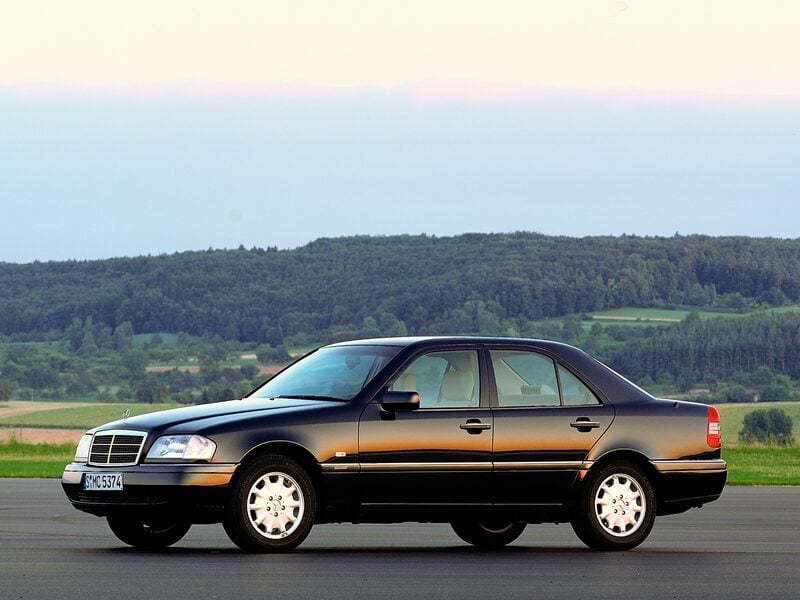
The Mercedes-Benz C-Class Series 202, successor to the legendary W 201, is celebrating its 30th anniversary this year. It can still be seen on the streets today, and some of its versions are of interest to collectors.
The world premiere of the new Mercedes C took place in 1993 in Prague, Czech Republic. The design of the 202 Series was timeless and elegant, and compared to its predecessor, the C-Class offered significantly more interior space. Additional space in the cabin is achieved through the correct arrangement of individual components such as the engine, axles and gearbox. The relocation of the fuel tank, which was installed behind the rear seat in the 190, was also a benefit. Compared to the W 201, the boot volume has also increased. All this with still compact dimensions - the length of the C-class has increased by about 40 mm. A station wagon variant, internally designated S 202, was released in 1996.
Safe body
Much attention has been paid to safety. Reinforced side moldings were used, the doors were reinforced with tubular construction, and a three-ply B-pillar connected to the sill by a wide, strong base. Massive cross members under the front seats transmitted forces to the central tunnel and the undamaged side of the car. Reinforcements in the sills prevented them from bending and collapsing. The seats are also designed for high rigidity so that they can transmit forces without deforming. At the same time, the designers of the 202 series took care of the environment, so that 85 percent of the car can be recycled at the end of its life.
Forerunner of 4-valve-per-cylinder technology.
At the time of its debut, the C-Class was available in four petrol and three diesel versions. The C 180 variant had a power of 122 hp, the C 200 had 1136 hp, the C 220 had 150 hp, and the C 280 with a six-cylinder in-line engine produced 193 hp. Among the diesels, the C 200 D (75 hp) was the base variant. The more powerful C 220 Diesel developed 95 hp and the C 250 Diesel 83 kW (113 hp). The new petrol engines had more torque and more power than the W 201. Exhaust gas quality was also greatly improved. Mercedes-Benz was the first manufacturer in the world to introduce four-valve technology also for diesel engines.
improved chassis
They also took care of improving handling and ride comfort. The front axle with double wishbones has optimized wheel handling. The multi-link rear suspension known from Baby Benz has been modified to include a flexible differential mount. New spring and damper settings, as well as a longer wheelbase and wider track, have also contributed to improved driving comfort and safety.
Four stylistic lines
Standard equipment on the C-Class included: driver’s airbag, integrated side impact protection, anti-lock braking system ABS, power steering, five-speed transmission and central locking. In addition to the so-called In the classic version, later called the Classic, Mercedes-Benz offered a new limousine in the Esprit, Elegance and Sport lines. The Esprit and Sport variants had 25mm lower suspension. The Classic and Elegance lines were the most popular (1/3 of the cars delivered).
C 63 AMG with 280 hp
The top variant of the 202 series was first introduced in autumn 1993 with the C 36 AMG. This is the first car developed jointly by Mercedes-Benz and AMG. It was based on the C 280 variant from the Sport equipment line. AMG engineers have increased the diameter and stroke of the 2.8-liter six-cylinder engine to a displacement of 3.6 liters. The power of the unit was 280 hp. Compared to the Sport variant, the suspension is further lowered by 10 mm (only 35 mm compared to the base versions). From autumn 1993 to June 1997, 5,221 C 36 AMGs were produced. In September 1997, an eight-cylinder engine made its debut under the hood of the C-Class, developing 306 hp in the new C 43 AMG variant. The C 55 AMG, introduced in 1998, increased its power to 347 hp.
Numerous updates
During the production period from 1993 to 2000 (sedan) and from 1996 to 2001 (station wagon), numerous visual and technical improvements were made to the C-Class. For example, in 1995 the C 230 Kompressor variant was fitted with a Roots compressor. After a model update in 1997, the C 240 and C 280 variants were offered with new V6 engines. They could be ordered with the new electronic stabilization program ESP. There were also side airbags in the front doors, high performance belt tensioners with force limiters for the front seats, and brake booster. The C 250 Turbodiesel variant was the first passenger car with a turbocharged diesel engine, equipped with a four-valve cylinder head and an intercooler. The engine developed 150 hp. In 1997 Common Rail technology was added to the C class.
From 1993 to 2001, almost 1.9 million sedans and station wagons rolled off the assembly line. Thus, the first C-Class built on the success of its famous predecessor, the Model 190 (W 201), commonly known as the “Baby Benz”.
Source: Wprost

I am Jason Root. I work in the news website industry and mostly cover the automobile industry. I have also written for Daily News Hack. My work revolves around new car models, prices, and features. In addition, I often write about used cars and tips for buying them. My articles are meant to be helpful for those who are in the market for a new or used car.

