
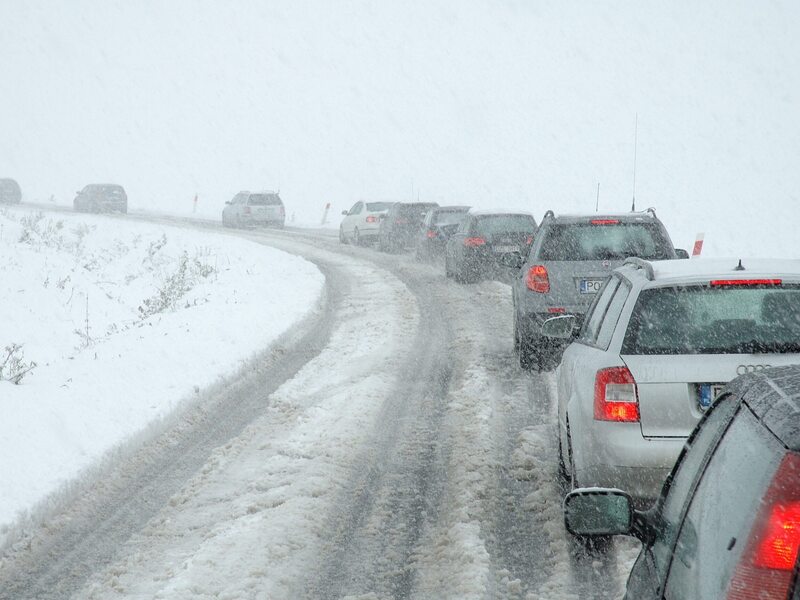
From January 15 to February 25, you can expect an increase in traffic on roads of national importance, especially in mountainous regions. This is due to the winter holidays, which are spread over two-week periods and fall on different dates depending on the voivodeship. Road workers call for common sense and compliance with safety rules while traveling.
Traffic experts (General Directorate of National Roads and Highways) shared important rules for safe travel with drivers. They remind you that when going on a longer route, it is necessary to take into account unfavorable weather conditions, which may extend the journey time. “The weather can be changeable - snowfalls, sleet, freezing temperatures. Let’s drive wisely, remembering that braking distances are longer on wet surfaces and you can easily lose traction. Let’s adjust the speed to the current weather conditions and traffic intensity,” write the road workers.
Road maintenance in winter
At the same time, road workers, who account for 5 percent of the 420 thousand km of roads in Poland, are reminded that work closely related to winter road maintenance, in particular the removal of snow and slippery roads, is carried out 24 hours a day, 7 days a week .
During the winter season, several thousand people will work to combat slipperiness and clear snow on roads of republican significance, for which the State Traffic Safety Inspectorate is responsible. They have about 2,700 vehicles at their disposal, including: plows, salt plows and rotary plows. The road workers also have 283 warehouses with a total value of more than PLN 470,000. tons of salt, 2.6 thousand tons of calcium chloride and 26 thousand tons of roughening materials.
Roads are black only in summer
Road workers remind you that during heavy snowfall the road cannot be black. A few minutes after the plow passes, it becomes covered with snow again. In the right lane (on roads with many lanes), the surface remains black longer than in the left lane. This usually happens because there are more cars driving in the right lane, spreading the salt across the road, making it work faster.
Driver! Do you want to go for a ride? Let it pass!
Road workers call vehicles to pass, whose task is to clear the roads of snow. Impeding their work, for example by preventing them from passing on the road or blocking it, poses a threat to the health and lives of both service workers and other road users.
Road workers remind you that the equipment is wide, some of it covers the entire road, and moves slowly, at a speed of about 40-50 km/h. Although traffic services use yellow traffic lights rather than blue ones like police or emergency services, they play a role similar to that of law enforcement and emergency services.
Removing snow from the car and using headlights correctly
In their appeal, road workers note that there are still drivers who need to scrape frost and ice from a small part of the windshield in order to pass. The snow cap is not removed from the car, as it is assumed that it will be blown away by the wind. This situation is a threat to other road users and a lack of responsibility, which may result in a fine.
In addition, during snow, some drivers drive only with daytime running lights on, and at dusk, with light fog, turn on front and rear fog lights to better see and be visible. Driving with daytime running lights in the rain means that those behind you will notice your vehicle too late. This also applies to cars with an automatic low beam switch, which does not always recognize weather conditions and, as a result, the rear lights turn off.
Important information for drivers
Finally, road engineers remind that drivers can use the GDDKiA website, where, among other things, they will find: information about what difficulties they can expect along the route and what the weather conditions are.
Detailed information on the condition of national roads can also be obtained by calling the 24-hour traffic information number GDDKIA 19 111. The number is served by traffic information points (PIDs) operating within the GDDKiA, which collect data on road conditions and make them available to road users and the media. Information also comes to GDDKIA Road Information from the drivers themselves.
Source: Wprost

I am Jason Root. I work in the news website industry and mostly cover the automobile industry. I have also written for Daily News Hack. My work revolves around new car models, prices, and features. In addition, I often write about used cars and tips for buying them. My articles are meant to be helpful for those who are in the market for a new or used car.

